

Measurement
Lectures
Understanding Measurement
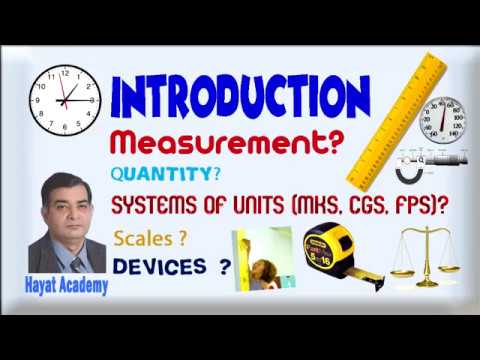
In this video named "Understandingto Measurement", we are providing thoughtful about “Understanding to Measurement”. In this lesson we have given an introduction that what Measurement is? And why we need a Unit for to Measurement of a quantity? And which types of Measuring Devices and Systems of units we use. In this lesson we have also tried to teach a concept of measuring system (MKS, CGS, FPS) with their different scales and units with the help of figures. This lesson is recommended for all grades.
Systems
of Units MKS CGS FPS
In this video named "Systems of Units MKS CGS FPS", we are providing understanding about all Systems of Units either they are in used or they are absolute (not in used). As well we will study base units of Systems and brief history of Systems. By this lesson we will know why some system Like: Absolute MKS, Absolute CGS, FPS, MkpS, MKfS, MTS, QES, HUS systems are stopped and why international system of units is now in use. This lesson is recommended for all grades.
Difference
Between SI Fundamental
and Derived Quantities
In this video named "Difference Between SI Fundamental and Derived Quantities", we are trying to understand that what “7 SI Base Physical Quantities” are? And how SI Derived Physical Quantities are formed by the combination of base SI Base Physical Quantities? And SI Base Physical Quantities are called with their Names expressed by a letter, and have a unit, and a formula definition. We have explained the term “Base” and “Derived” with the examples of construction of a house by bricks, and air and its composition, and tree is made up of with cells. This lesson is recommended for all grades.
How to
Create-Formation SI Fundamental
and Derived Unit
In this video named "How to Create-Formation SI Fundamental and Derived Unit", we are trying to learn about the Difference of "SI Fundamental Quantities" and "SI Derived Quantities". We will understate that Base Quantities are standalone and independent but all Derived Quantities are formed by the combination of two or more Base Quantities or Derived Quantities. And for measuring Derived Quantities we need magnitude and more than one unit (e.g. area, volume, speed, acceleration). This lesson is recommended for all grades.
How to
Write Base Units of Derived Quantities
In this video named "How to Write Base Units of Derived Quantities", we will study that how we can make/form Derived Quantities and their Units by combination of two or more Base Quantities or Derived Quantities. And what is Derived Quantities formula and how we can write Derived Quantities Unit in the form of its base units. (e.g. area, volume, Mass Density, Speed/Velocity, Acceleration/Retardation, Force, Pressure, Work, Power, Momentum).
Difference
between Meter and Metre,
Metre vs Meter
In this video named "Difference between Meter and Metre, Metre vs Meter", is an answer of a query received from students, and today we will learn that what is the difference in spelling of Word "Metre" and "Meter", and which spelling is correct. And why the two Words are used for a same meaning.
What
are Prefixes of SI Units
In this video named "What are Prefixes of SI Units", we will learn understanding of prefixes, and why we are adding a prefix before a unit? After combining a prefix with a unit the value of unit will change, so one base unit can be used multiple times by the combination of multiple prefix, which gives new meaning to a unit. After this learning, it will become easy to make a new standard unit by using a simple method. This lesson is recommended for all grades.
What
are Significant Figures and Rules
In this video named "What are Significant Figures and Rules", we will study, Significant Figures (or Digits) and it’s Mathematical Operation. In this Lesson we have described "7 Rules for finding Significant Figures of a Number" and we have presented two examples for each Significant Figure Rule for understanding its Mathematical Operation.
In Next Lesson "Significant Figures and Mathematical Operation" we will Understand the Mathematical Operation for "Addition, Subtraction, Multiplication, Divination, Power and Roots" of a two or more Numbers with satisfactory examples.
Significant
Figures and Mathematical Operations
In this video named "Significant Figures and Mathematical Operations", we will study, "Significant Figures (Digits) and Mathematical Operation Part 2". In this Lesson we have Understand Mathematical Operation "Addition, Subtraction, Multiplication, Divination, Power and Roots" of two or more Numbers and finding Significant Figures in Answer, with satisfactory examples.
In previous Lesson "Significant Figures (Digits) and Mathematical Operation Part 1", we have presented two Examples for each rule for understanding the significant figure? And we have described "7 Rules for Finding Significant figures of a Number", and understand with a few examples. And we have given introduction to understanding Mathematical Operation of Significant Figures.
Conversion
of Units using Factor-Label Method
Today in this video named "Conversion of Units using Factor-Label Method", we will study 3 methods for Unit Conversion of Physical Quantity:
1. By Factor-Label Method (by building a conversion equation)
2. By Arranging SI Prefixes Table (like a ratio) Method
3. By Moving (or Shifting) Decimal Point (Decimal Place) Method.
Here we are introducing a new trick named "drawing an Arrow Head" for identifying the Numerator in the fraction created by conversion equation. This trick will resolve the conflict that which side of equation will be Numerator and which will be denominator of a fraction. By using this trick, the conversion of any unit will become faster, error free and will give accurate answer. We will use this trick in Factor-Label Method and Arranging SI Prefixes Table (like a ratio) Method. Now we will study "Factor-Label Method" and in next lessons we will study other two Methods. This lesson is recommended for all grades.
Conversion
of SI Units using Metric Prefixes
In this video we will study Unit Conversion method of Physical Quantity named "Conversion of SI Units using Metric Prefixes". In previous lesson we have planed 3 methods for studied for Unit Conversion of Physical Quantity:
1. By Factor-Label Method (by building a conversion equation)
2. By Arranging SI Prefixes Table (like a ratio) Method
3. By Moving (or Shifting) Decimal Point (Decimal Place) Method.
There we have introduced a new trick named "drawing an Arrow Head" for identifying the Numerator in the fraction created by conversion equation. This trick has resolved the conflict that which side of equation will become Numerator and which will become Denominator of a fraction. By using this trick, the conversion of any unit has become faster, error free and had given accurate answer. We have used this trick in Factor-Label Method and Arranging SI Prefixes Table (like a ratio) Method.
Now we will study "Conversion of SI Units using Metric Prefixes" We will change the sign of power of 10 of Prefixes Table (Negative sign to positive and positive sign to Negative) in this way all powers of Prefixes Table, mutually in between, behave like an equation, so without finding units for creating equation, we can use these powers as a readymade equation, for our solution. This lesson is recommended for all grades.
Conversion
of SI Base Units by
Moving the Decimal
In this video we will study Unit Conversion of SI Physical Quantity named "Conversion of SI Base Units by Moving the Decimal", Only by Moving the Decimal Point from left to right or right to left in the number of SI Physical Quantity.
In previous lesson we have planed 3 methods for study and have learnt two of them:
1. By Factor-Label Method (by building a conversion equation)
2. By Arranging SI Prefixes Table (like a ratio) Method
There, we have introduced a new trick named "drawing an Arrow Head" for identifying the Numerator in the fraction created by conversion equation.
We have used this trick in Factor-Label Method and Arranging SI Prefixes Table (like a ratio) Method. And we have learnt "Conversion of SI Units by using Metric Prefixes" by changing the sign of power of 10 of Prefixes Table, in this way all powers of Prefixes Table, mutually in between, behaved like an ready-made equation. This lesson is recommended for all grades.
Conversion
of SI Derived Units using
Metric Prefixes
In this video named "Conversion of SI Derived Units using Metric Prefixes" we will study conversion of SI Derived Units by using by changing the sign of power of 10 of Prefixes Table, in this way all powers of Prefixes Table mutually behaved like an ready-made equation. And we will use new trick named "drawing an Arrow Head" for identifying the Numerator in the fraction created by conversion equation.
This method seems like a magic and by pass numbers of working steps, very easily we can solve complicated conversion calculations. This lesson is recommended for all grades.
Conversion
of Customary Base Units
(Part 1)
In this video named "Conversion of Customary Base Units (Part 1)" we will study conversion of Customary Base Units Like: Volume, Mass, Length, Time, Indian Units (Length and Mass) by building conversion equation from units, creating fraction and multiplying this fraction with given original value, very easily.
This lesson is recommended for all grades.
Conversion of Customary Derived Units
(Part 2)
In this video named "Conversion of Customary Derived Units (Part 2)" we will study conversion of Customary Derived Units Like: Force, Pressure, Energy, Power by building conversion equation from units, creating fraction and multiplying this fraction with given original value, very easily. As we have learnt in previous lesson with details. This lesson is recommended for all grades.
How to
Convert an Angle Measure
(From Degree-Gradian-Radian etc.)
In this video named "How to Convert an Angle Measure (From Degree-Gradian-Radian etc.)" we will study conversion of Angle Measure Like: Revolution, Radian, Degree, Binary Radian, Gradian, Points, Octant, Quadrant, Straight Angle by very easily methods, learnt in previous lessons with details. This lesson is recommended for all grades.
Conversion
of Temperature
(Kelvin-Celsius-Fahrenheit-Rankine-
Delisle-Newton-Reaumur-Romer)
In this video named "Conversion of Temperature (Kelvin-Celsius-Fahrenheit-Rankine-Delisle-Newton-Reaumur-Romer)" we will study conversion of Temperature Scales Like: Kelvin, Celsius, Fahrenheit, Rankine, Delisle, Newton, Reaumur, Romer in between. We have created a new formula (which have not used before) created by the Freezing Point and Boiling Point. This formula is very simple and easy to remember and use for everyone. For example, if we want to conversion Temperature Scales i.e. Kelvin, Celsius, Fahrenheit in between then we have to remember only three formulas, which is very easy to implement.
We have tested these formulas by putting average human temperature and converted form Kelvin -> Celsius -> Fahrenheit -> Rankine -> Delisle -> Newton -> Reaumur -> Romer to Kelvin again. We found same answer which was putted for first conversion. This lesson is recommended for all grades.
Conversion
of Temperature
(Kelvin-Celsius-Fahrenheit)
In this video named "Conversion of Temperature (Kelvin-Celsius-Fahrenheit)" we will study conversion of Temperature Scales Like: Kelvin, Celsius, Fahrenheit in between. We have created a new formula (which have not used before) created by the Freezing Point and Boiling Point. This formula is very simple and easy to remember and use for everyone. For example, if we want to conversion Temperature Scales i.e. Kelvin, Celsius, Fahrenheit in between then we have to remember only three formulas, which is very easy to implement.
This lesson is recommended for all grades.
https://www.youtube.com/watch?v=7qNN0F7w7Qc
Measurement
- Solution of
Problem 2.2 , 2.3 and 2.4
Measurement Lectures Overall
 Reviewed by Hayat Academy
on
August 24, 2018
Rating:
Reviewed by Hayat Academy
on
August 24, 2018
Rating:
Reviewed by Hayat Academy
on
August 24, 2018
Rating:



No comments: